FalconSmith

If your system was deleted today

could you rebuild it from scratch?

The code would still be there.

The system around it is usually not reproducible.

Environments drift.
Toolchains change.
Dependencies disappear.
FalconSmith removes that class of failure.
FalconSmith makes Python and native builds deterministic - including C++ and Rust - across machines.
Most teams only discover this problem when it is already expensive.
Deterministic systems.
Embedded foundation.
Reproducible from a clean machine.
Inspect the system directly: System documentation and Generated documentation. (opens separately)

Current validated baseline

FalconSmith is currently validated on Windows 10/11 x64 for Python 3.13, embedded CPython, embedded uv, MinGW/GCC, Rust, C++ native extensions, offline wheelhouses, test execution, and Sphinx documentation generation.

Every environment is verified against a hash-pinned, git-tracked manifest: runtime components are sha256-verified on delivery, drift is reported on every activation, and every reconciliation is retained in an append-only audit history.

Linux support is the next target platform and is being developed against the same runtime-manifest, artifact-registry and verification model.

FalconSmith is not presented as a universal replacement for Docker, Nix, Bazel, Poetry, Conda, or uv.

It is designed for teams that need deterministic engineering environments around long-lived Python + native codebases.

What actually breaks

Most software failures are not code failures.

They are system failures.


Rebuilds slow down over time.

Onboarding depends on tribal knowledge.

Native layers become fragile.

Documentation diverges from reality.

Systems drift silently.

A new developer joins the team

Background:

Your main server has a central FalconSmith installed.

The source code is pushed to git and the runtime foundation is shared on the internal network.

The demo machine has never seen the system before.

In this demo, the repository contains the source code. The approved runtime foundation is synced from the main FalconSmith installation. The local machine starts naked, without anything configured. No Python, no toolchains, no virtual environments.

DEMO FILM - BEING RE-RECORDED UNDER THE FALCONSMITH BRAND
Fresh machine to verified, documented system in under two minutes.

Fresh machine. Empty folder. Runtime reconstruction, native compilation, verification, and documentation generation in under two minutes.

  • 1. Clone source code from Git.
  • 2. Sync the approved runtime foundation.
  • 3. Materialize user and developer environments.
  • 4. Compile C++ and Rust native modules locally.
  • 5. Run the verification suite.
  • 6. Generate synchronized documentation.
In the reference build: 233 tests executed on every rebuild · every artifact sha256-pinned · zero network access during build · three isolated environments.

Where FalconSmith fits

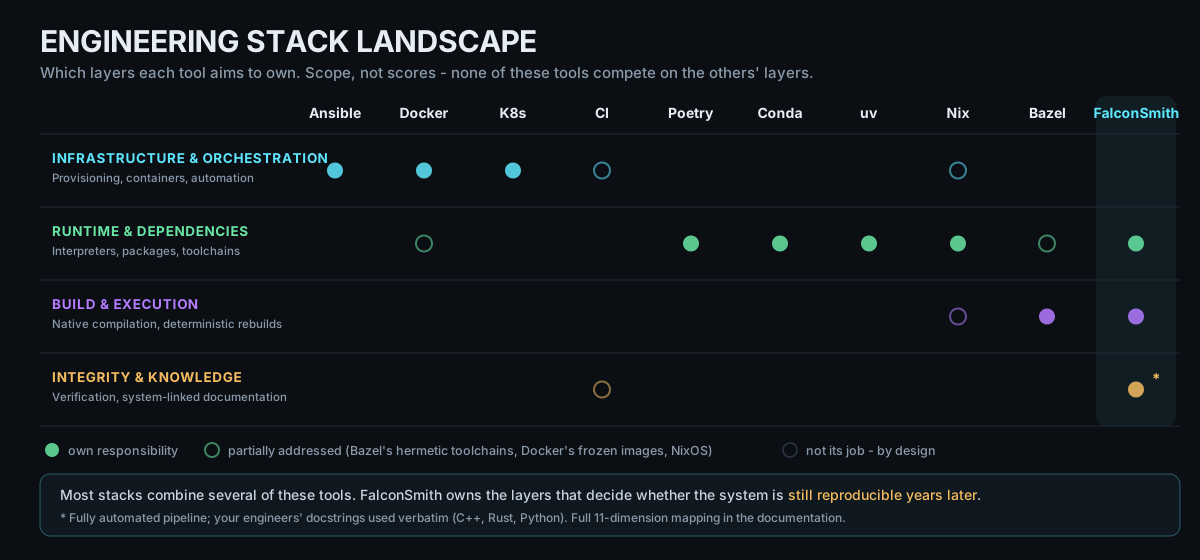
Most engineering organizations already use excellent tools: Docker, uv, Poetry, Conda, Nix, Bazel, Kubernetes, and CI systems.

FalconSmith is not intended to replace them.

It focuses on a different problem: deterministic runtime ownership, verification, and reproducibility across the engineering stack.
Engineering stack landscape showing which layers each tool aims to own - scope, not scores Engineering stack landscape showing which layers each tool aims to own - scope, not scores

No single tool covers the entire stack.

FalconSmith focuses on the parts that determine whether a system remains reproducible years later - not just whether it builds today.

Rebuilding a system is only the beginning

The onboarding demo shows a clean reconstruction of the engineering environment.

That solves the first problem.

The harder problem is what happens afterward.

Developers experiment.
Dependencies change.
New tools are introduced.
AI agents generate code.
Temporary fixes become permanent.

Over time, every engineering environment drifts.
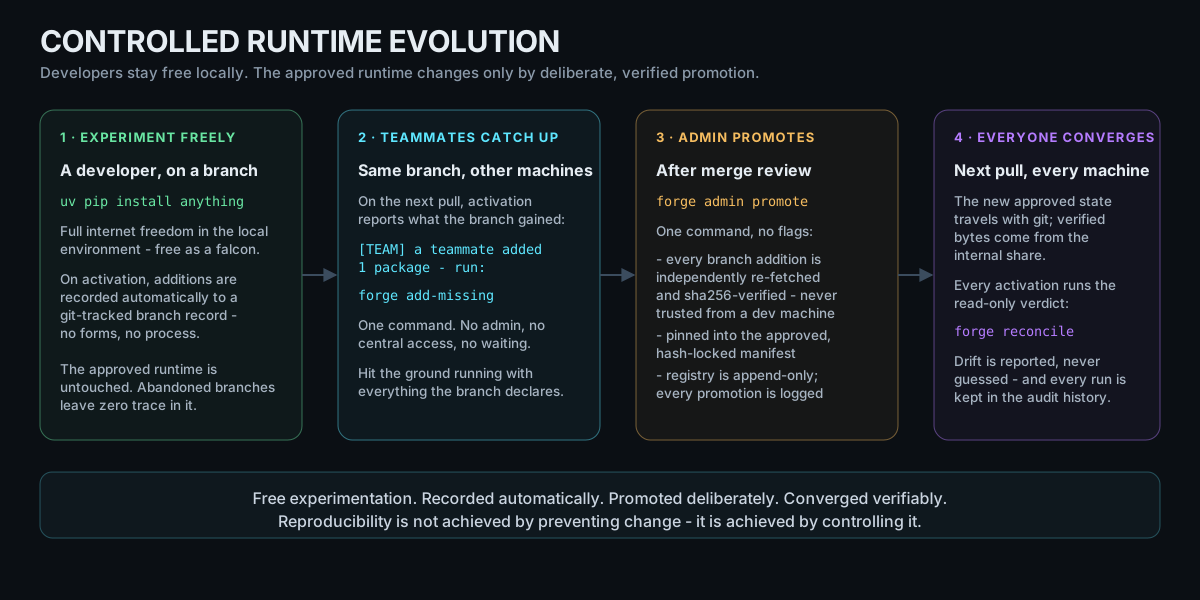
The question is not whether change happens, but whether that change remains controlled.

FalconSmith treats runtime evolution as a first-class engineering problem.

Developers remain free to experiment locally - free as a falcon.

The official runtime remains explicit, reviewable, and deterministic.

This is not a policy document. It is working tooling: a developer's additions on a branch are recorded automatically, a teammate picks them up with one command, and an administrator promotes them into the approved runtime with one command - independently re-fetched and hash-verified, never trusted from a developer's machine.

Controlled runtime evolution in FalconSmith - developer freedom, teammate hand-off, administrator promotion, verified convergence

The demo shows how a system is reconstructed on day one. This model shows how the runtime evolves on day one hundred.

Reproducibility is not achieved by preventing change.

It is achieved by controlling it.

Drift is measured, not guessed

FalconSmith records machine-readable state for each environment: dependency snapshots, environment snapshots, embedded toolchain versions, runtime fingerprints, and local deviation from the approved runtime manifest.

dependency_snapshot.json

Exact package versions and dependency fingerprint.

environment_snapshot.json

Python, uv, compiler, Rust, CMake, platform, and environment identity.

dependency_manifest.json

The approved, hash-pinned runtime state used for reconciliation.

The question is not whether a machine has drifted. The question is what changed, where, and whether it was approved.

The anatomy of drift

Software systems rarely fail all at once. They drift - and they drift in the same places every time.

1. Environment

Python versions change. Packages disappear. Toolchains evolve. The original assumptions vanish.

2. Structure

Modules move. Shortcuts accumulate. The architecture becomes harder to understand.

3. Operations

Builds, tests, and workflows come to depend on people instead of systems.

4. Documentation

The system evolves. The documentation remains. Eventually they describe different realities.

FalconSmith treats these as one problem.

Because they are.

Delivered, not installed

FalconSmith treats the surrounding system as part of the deliverable. Runtime. Toolchains. Dependency state. Native build paths. Verification. Documentation.

FalconSmith system architecture - manifest, registry, embedded runtime, environments, verification
  • Embedded Python runtime
  • Embedded compiler toolchains
  • Pre-resolved dependencies
  • Offline installation
No external assumptions.
No system dependencies.
No external drift.
Everything is derived from a manifest. If it is not defined, it does not exist.
If the host machine changes, the system does not.

Package managers own dependencies.

Build systems own compilation.

CI systems own automation.

FalconSmith owns reproducibility.

The goal is not to replace the systems you already use. The goal is to ensure that the system they create remains rebuildable over time. This is not environment management. This is environment ownership.

Example

Python + C++ library across multiple machines

Before

Different developer setups

Native modules fail by environment

Rebuild requires undocumented steps

With FalconSmith

Embedded foundation is delivered and shared

Developers reproduce the same system locally

Native modules compile deterministically using the same toolchain everywhere

Documentation matches the system

Result

Rebuildable from a clean machine

No setup. No hidden steps. No drift.
If your native code depends on the host machine, it is not deterministic.

How source and foundation move through an organization

Code is versioned. The embedded foundation is controlled. Systems are reproduced locally.

FalconSmith distribution model - code and manifest travel via git, verified runtime bytes via the internal share
Source code and foundation are separated.
Pull code -> Sync foundation -> Create environments -> Run tests -> Verify
Same code. Same foundation. Same environments. Same verification.
What travels: source code, manifest, small test files
What does not travel: compiled binaries, full runtime payloads

Every machine compiles locally. Every build is deterministic.

Native code, Python ergonomics

# Native C++ function, imported like normal Python
from fs_lib.portal.io.ascii_csv_reader import read_ascii_csv
from fs_lib.portal.math.cumul_avg import cumulative_average

# Standard Python module
from fs_lib.<module>.<file> import <function>  # or <class>

Native code imports like Python. No hand-written wrapper layer required.

Who this is for

Good fit

Python + native code

C++ or Rust integration

Multiple developers or future maintainers

Long-lived engineering systems

Reproducibility requirements

Probably not necessary

Short-lived prototypes

Small systems with one maintainer

Pure Python projects with simple dependencies

Projects where rebuild failure is acceptable

Teams that do not need native or offline reproducibility

FalconSmith owns the plumbing. You own the product.

FalconSmith separates the reusable engineering engine from the client library it helps create.

falcon_smith/

The deterministic orchestration engine: runtime handling, native build plumbing, namespace generation, verification, and documentation flow.

src/

Your algorithms, workflows, hooks, native units, domain logic, configuration, and intellectual property.

FalconSmith is delivered as versioned plain-text Python under NDA. Clients may inspect and modify the engine, and maintain their internal copy if required, while client code remains structurally isolated in src/.

No lock-in, by construction

Plain text

The entire engine ships as readable Python source. No compiled binaries, no encrypted payloads, no black boxes.

Standalone runtime

The delivered library runs with zero dependency on the vendor. Nothing phones home. Nothing expires.

You own the library

All project code, native sources, artifacts, tests, and documentation are yours - to keep, modify, and redistribute.

Inspect first

Architecture and generated documentation are open for technical due diligence before any commitment.

Whatever happens to the vendor, your system keeps building.

Deeper

The architecture, delivery process, and verification model are documented for inspection: open system documentation and generated documentation.

Reality check

Most teams assume their system is reproducible.

Very few actually test it.

Delete the environments. Delete the build artifacts. Start from a clean machine. What breaks?

If the answer depends on tribal knowledge, undocumented setup steps, or machine-specific behavior, FalconSmith may be relevant.

A FalconSmith pilot is not a generic trial or scripted demo. It is a targeted implementation of one real Python + C++/Rust workflow, preferably a workflow that currently causes onboarding, build, dependency, native compilation, or documentation drift problems.

Request a pilot